A coffee bag has one job that matters far more than how it looks on a shelf: slowing the moment the coffee inside starts to taste flat. Freshly roasted beans are chemically busy, shedding gas and reacting with everything around them, and the difference between coffee that still reads bright at four months and coffee that reads papery at four weeks is almost entirely the bag’s construction. The laminate, the valve, and the seal do the work. Here is what each part does, the numbers that describe how well it does it, and what to ask a supplier for.
What actually stales coffee
Four things turn good coffee dull: oxygen, moisture, light, and the coffee’s own carbon dioxide. Oxygen is the main culprit, because it oxidizes the volatile aromatic oils that carry most of what you taste and smell, and it is the enemy the bag is built to fight. Moisture accelerates the same reactions and can push oily beans toward rancidity. Light, especially UV, degrades those oils further, which is why most barrier bags are opaque. Carbon dioxide is the odd one out: the coffee is producing it, not absorbing it, and that single fact is the reason a coffee bag cannot simply be sealed airtight the way a bag of chips can.
The laminate does the work
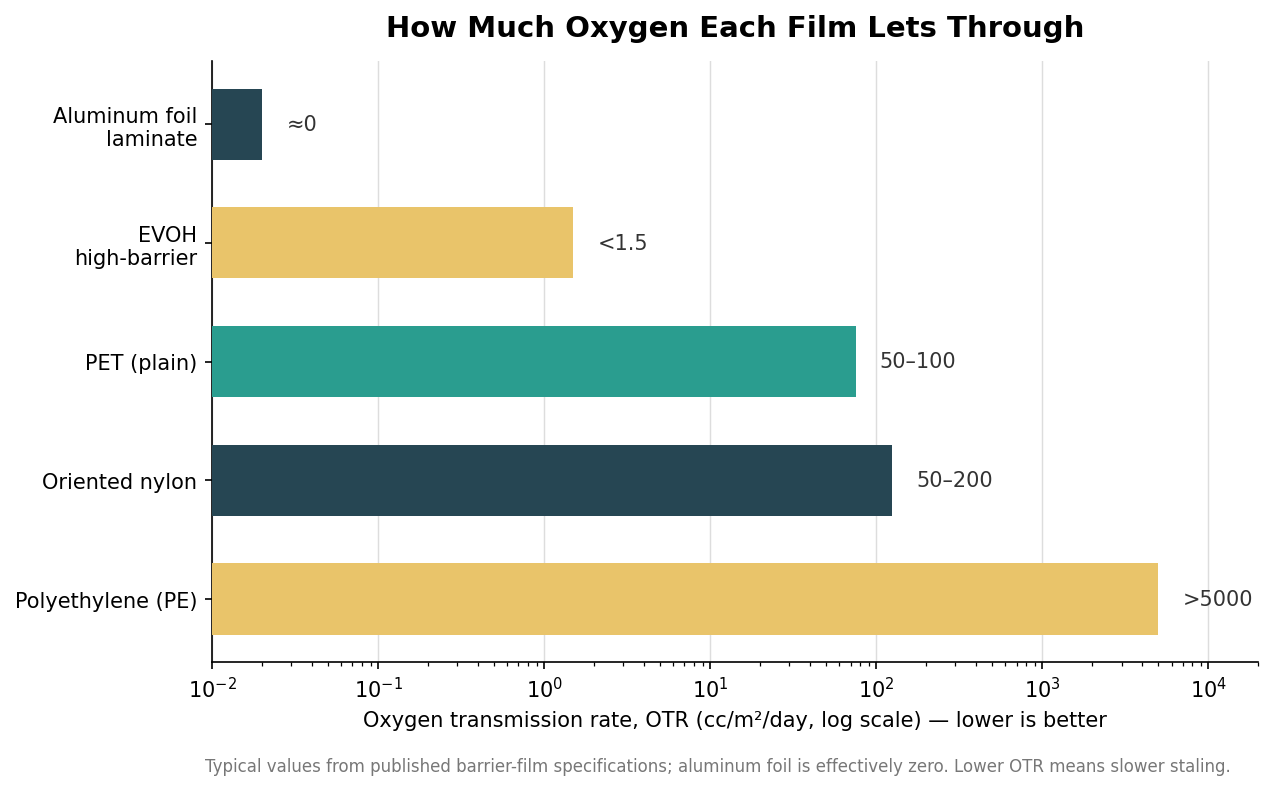
A quality coffee bag is usually not one material but a laminate, several thin layers bonded together, each with a job. The industry reference structure is PET / aluminum foil / PE: an outer PET layer around 12 microns for strength and printability, a core of aluminum foil roughly 7 to 9 microns thick that provides the actual oxygen barrier, and an inner polyethylene layer of 60 to 100 microns that melts to form the heat seal. The barrier layer is where freshness lives, and its performance is measured as oxygen transmission rate, or OTR: the volume of oxygen that creeps through a square meter of film in a day. Lower is better. Aluminum foil laminate sits at essentially zero. A high-barrier EVOH layer comes in under about 1.5. Plain PET runs 50 to 100, oriented nylon 50 to 200, and bare polyethylene is north of 5,000, which is exactly why a simple poly bag does almost nothing for shelf life.
Why fresh roast cannot be sealed airtight
Even a perfect barrier fails without a valve, and the reason is the coffee itself. Freshly roasted beans off-gas carbon dioxide for days after roasting, up to around ten liters per kilogram. Seal that into an airtight foil bag and it inflates like a balloon and can split a seam. The one-way degassing valve solves it: it opens under the internal pressure to let CO2 escape, then closes so outside oxygen cannot get back in once pressure equalizes. That one component is what lets a roaster bag coffee within hours of roasting instead of waiting days for it to settle. The barrier and the valve are a pair, not alternatives; a valve on a poor-barrier bag still lets oxygen in around the clock, and a foil bag without a valve either bursts or forces a delay that costs freshness on the front end.
Foil versus recyclable high-barrier
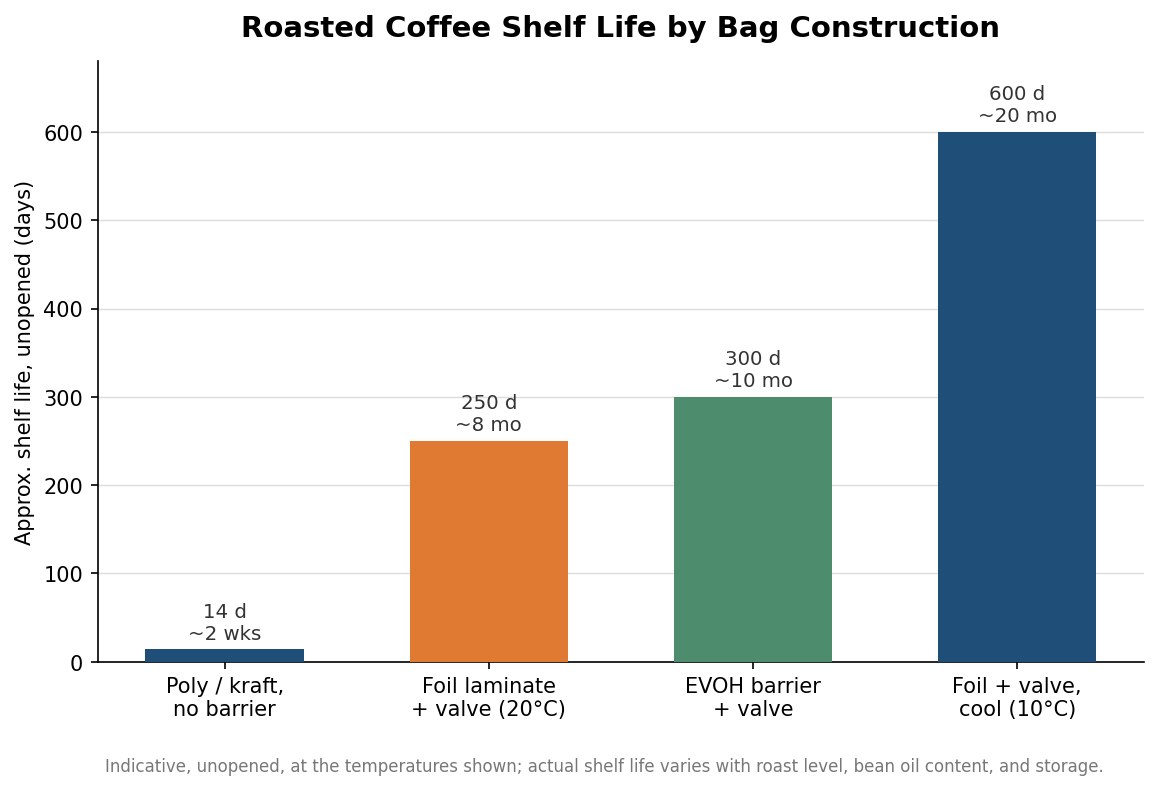
The main tradeoff in coffee packaging today is barrier against recyclability. Foil gives the best oxygen barrier there is, but a foil laminate is not curbside recyclable because the metal layer cannot be separated from the plastics. A metal-free high-barrier structure such as PET/EVOH-PE gives up a little barrier in exchange for a recyclable, single-stream-friendly bag. In shelf-life terms, a PET/foil/PE bag with a valve holds quality for roughly 250 days at 20 degrees Celsius, and past 600 days when kept cool near 10 degrees, while a recyclable EVOH high-barrier bag typically protects an unopened bag for about 8 to 12 months. Treat those as indicative, unopened figures at controlled temperature; real shelf life depends on roast level, how oily the bean is, and how warm the storeroom gets in August.
What to spec for your shelf-life target
Work backward from how long the coffee actually needs to survive. A fast-turnover subscription that ships within days of roasting can lean on a lighter structure, because the coffee is brewed long before oxygen becomes the story. A retail bag that may sit on a shelf for months needs foil or a strong EVOH barrier paired with a valve. Wholesale and export, where the coffee travels and waits, is where nitrogen flushing earns its keep, purging oxygen from the headspace at the moment of filling so the barrier starts from near-zero oxygen rather than sealing in a bag full of room air. Whatever the target, confirm three things with your supplier: the OTR of the film, the presence and rating of the valve, and the seal integrity, because the strongest laminate in the world still leaks through a weak seal.
The bag is food engineering
A custom coffee bag is not packaging in the decorative sense; it is a small piece of food engineering that happens to carry your logo. Match the barrier to your shelf-life window, add a valve so you can bag fresh, keep it out of the light and the heat, and the coffee arrives tasting the way it did on the cupping table. Every figure here is a starting point rather than a promise, so confirm the OTR, the valve rating, and the shelf-life claim against your own coffee and your supplier’s spec sheet before you commit a print run.