Two coffee bags can hold the same twelve ounces of beans and give a customer completely different impressions on the shelf. The difference is the format, the structural style of the bag, and it decides how the package stands, how much room you get for artwork, and how it fits the way you actually sell. Roasters tend to obsess over materials and valves, which matter, but the format is the choice a shopper reads first from across the aisle. This is a straight comparison of the three formats most specialty roasters choose between, and how to match one to the way your coffee moves.
The three to know are the side-gusset bag, the stand-up pouch, and the flat-bottom bag, also called a quad-seal or box-bottom. They are not just cosmetic variations. Each has a different number of printable surfaces, a different footprint on the shelf, and a different sweet spot for size and sales channel.
Side-gusset: the traditional coffee brick
The side-gusset bag is the shape most people picture when they think of coffee packaging: tall and narrow, with pleats folded into both sides that expand as the bag fills, giving it that classic brick silhouette. It is the workhorse of the industry for good reasons. It runs well on high-speed filling equipment, uses material efficiently, and holds a lot of coffee in a compact footprint, which is why it dominates the one-pound and larger sizes aimed at regular drinkers and wholesale accounts.
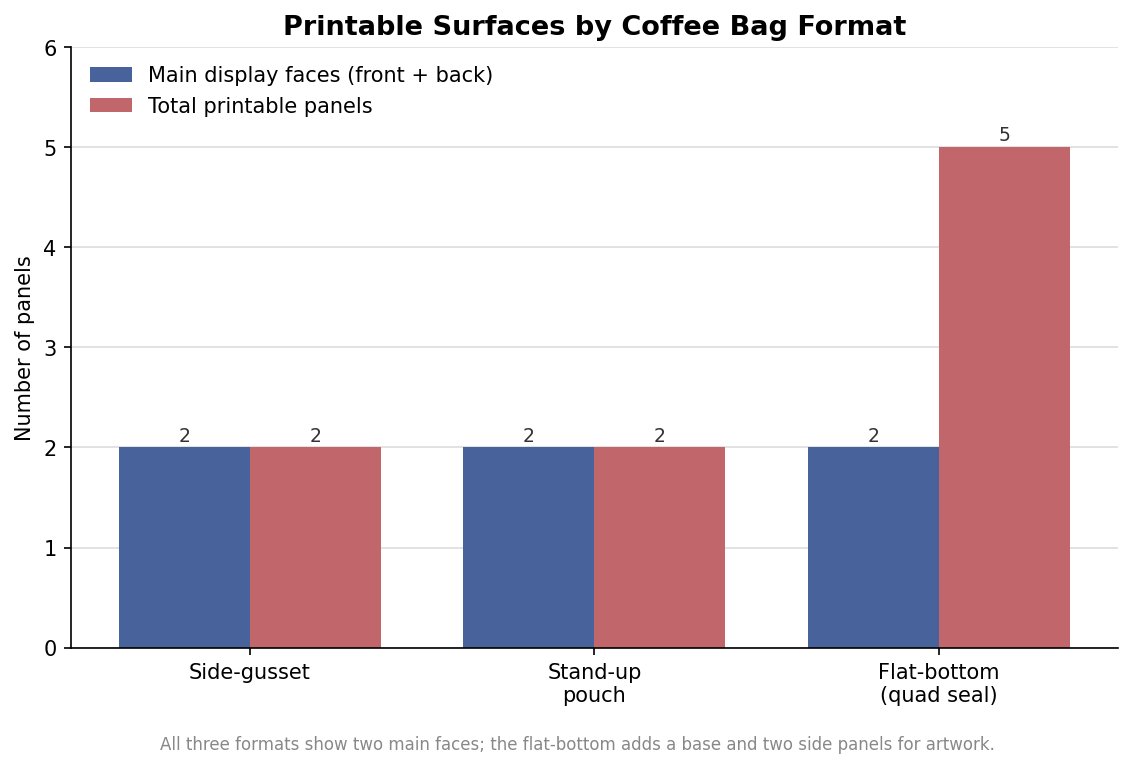
Its trade-off is display. The pleated sides mean your artwork really lives on the two main faces, and the bag reads as functional rather than boutique. A tin tie across the top is the common closure, folding down over the top seal. If your coffee sells mostly to people who already know they want it, by the pound, by subscription, or into cafes, the side-gusset does the job with the least packaging cost per bag.
Stand-up pouch: the retail and online default
The stand-up pouch, sometimes called a doypack, has a rounded bottom gusset that lets it stand on its own once filled. It is compact, modern, and photographs well, which is exactly why it has become the default for online sales and smaller retail sizes. A resealable zipper across the top is standard, and a hang hole lets it go on a peg as easily as a shelf. For sample sizes and the eight-to-twelve-ounce range that dominates direct-to-consumer, it is hard to beat on flexibility.
Like the side-gusset, its printable area is essentially the front and back, so complex wrap-around artwork is not its strength. What it offers instead is a clean, upright face that looks good in a product photo and a shape that ships and stores efficiently. If most of your bags are opened by the customer who bought them online, the stand-up pouch is usually the pragmatic pick.
Flat-bottom: the premium shelf statement
The flat-bottom bag, built with a quad seal and a rigid base, stands tall and square like a small box. It is the most structured of the three and the one that most clearly says premium. The reason goes beyond looks: because of how it is constructed, it gives you up to five printable panels, the front, back, the flat base, and both sides, instead of the two you get on the other formats. That extra real estate is room for a story, brewing notes, or origin detail without crowding the main face.
The trade-offs are cost and fit. Flat-bottom bags typically carry a higher unit price and can require a higher minimum order, and they take up more shelf depth than a side-gusset holding the same weight. They shine for specialty and gift-oriented coffee where the package is part of the product, and they can look oversized on a bag meant to be bought by the pound and thrown in a pantry. If you are competing on shelf presence in a specialty grocer or building a gift-worthy line, the flat-bottom earns its premium.
Then choose the size for the customer, not the format
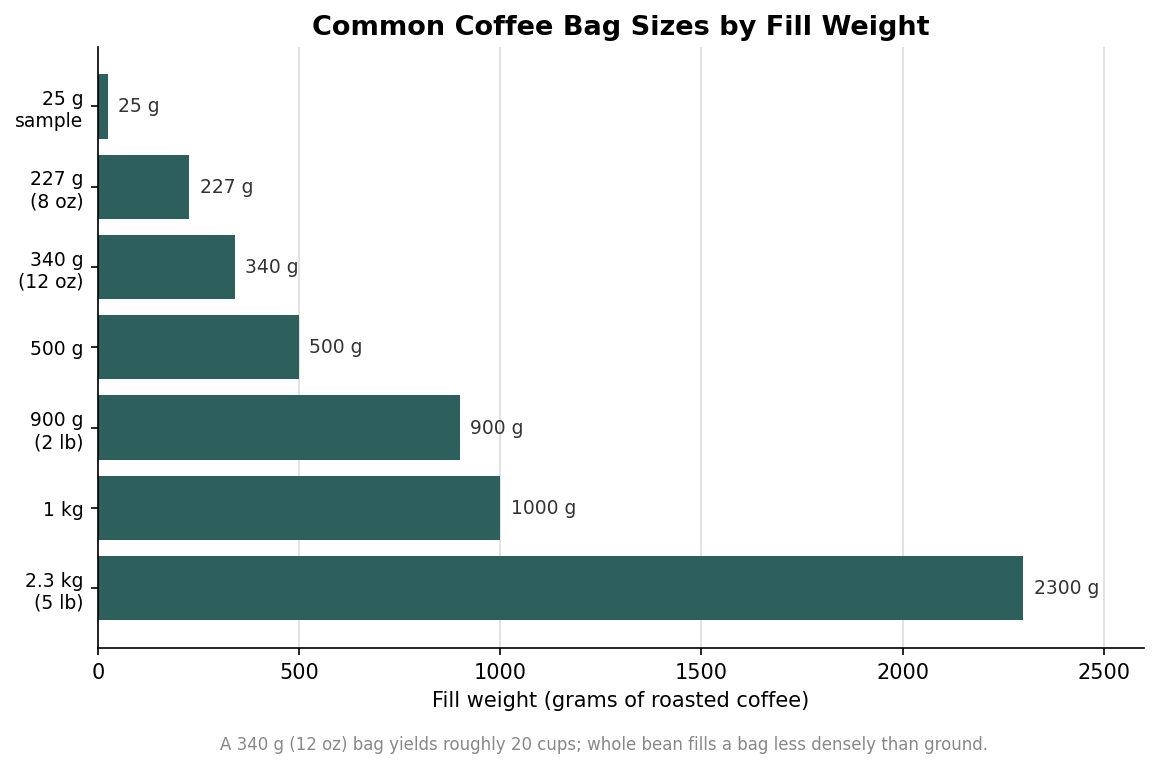
Format and size are separate decisions, and the size should follow how your customer buys. A handful of weights cover almost the entire market. A 25-gram pouch is a sample or promo. The 227-gram, or 8-ounce, bag suits customers sampling several roasts. The 340-gram, or 12-ounce, bag is the North American retail standard and yields roughly twenty cups. From there, 500 grams, 900 grams (about two pounds), one kilogram, and the 2.3-kilogram (5-pound) bulk bag serve progressively heavier or wholesale buyers.
Most roasters land on three or four sizes rather than one, typically a small retail bag, a standard bag, and a bulk option. One detail worth keeping in mind when you spec dimensions: whole beans fill a bag less densely than ground coffee, so a bag sized snugly for ground product can look underfilled when you put the same weight of whole bean into it. If you sell both, size the bag to the whole-bean fill so neither version looks skimpy. These weights are the common stock sizes; a packaging supplier can confirm the exact bag dimensions that hold each fill for your particular bean density.
Features ride on top of any format
The parts people fixate on, the one-way degassing valve that lets fresh-roasted carbon dioxide escape without letting oxygen in, and the resealable zipper or tin tie, are available across all three formats. They are not what separates the bags. That means you can pick the format for how you sell and the size for how your customer buys, then add the valve and closure as near-universal options on top. Decide the structure first, in other words, and treat the valve and zipper as the checkboxes they are rather than the headline. Get the format matched to your channel and the size matched to your buyer, and the bag will do its job on the shelf and in the cupboard.