Category: Uncategorized

  • What Keeps Coffee Fresh in the Bag: Barrier Films, Valves, and Shelf Life

    What Keeps Coffee Fresh in the Bag: Barrier Films, Valves, and Shelf Life

    A coffee bag has one job that matters far more than how it looks on a shelf: slowing the moment the coffee inside starts to taste flat. Freshly roasted beans are chemically busy, shedding gas and reacting with everything around them, and the difference between coffee that still reads bright at four months and coffee that reads papery at four weeks is almost entirely the bag’s construction. The laminate, the valve, and the seal do the work. Here is what each part does, the numbers that describe how well it does it, and what to ask a supplier for.

    What actually stales coffee

    Four things turn good coffee dull: oxygen, moisture, light, and the coffee’s own carbon dioxide. Oxygen is the main culprit, because it oxidizes the volatile aromatic oils that carry most of what you taste and smell, and it is the enemy the bag is built to fight. Moisture accelerates the same reactions and can push oily beans toward rancidity. Light, especially UV, degrades those oils further, which is why most barrier bags are opaque. Carbon dioxide is the odd one out: the coffee is producing it, not absorbing it, and that single fact is the reason a coffee bag cannot simply be sealed airtight the way a bag of chips can.

    The laminate does the work

    A quality coffee bag is usually not one material but a laminate, several thin layers bonded together, each with a job. The industry reference structure is PET / aluminum foil / PE: an outer PET layer around 12 microns for strength and printability, a core of aluminum foil roughly 7 to 9 microns thick that provides the actual oxygen barrier, and an inner polyethylene layer of 60 to 100 microns that melts to form the heat seal. The barrier layer is where freshness lives, and its performance is measured as oxygen transmission rate, or OTR: the volume of oxygen that creeps through a square meter of film in a day. Lower is better. Aluminum foil laminate sits at essentially zero. A high-barrier EVOH layer comes in under about 1.5. Plain PET runs 50 to 100, oriented nylon 50 to 200, and bare polyethylene is north of 5,000, which is exactly why a simple poly bag does almost nothing for shelf life.
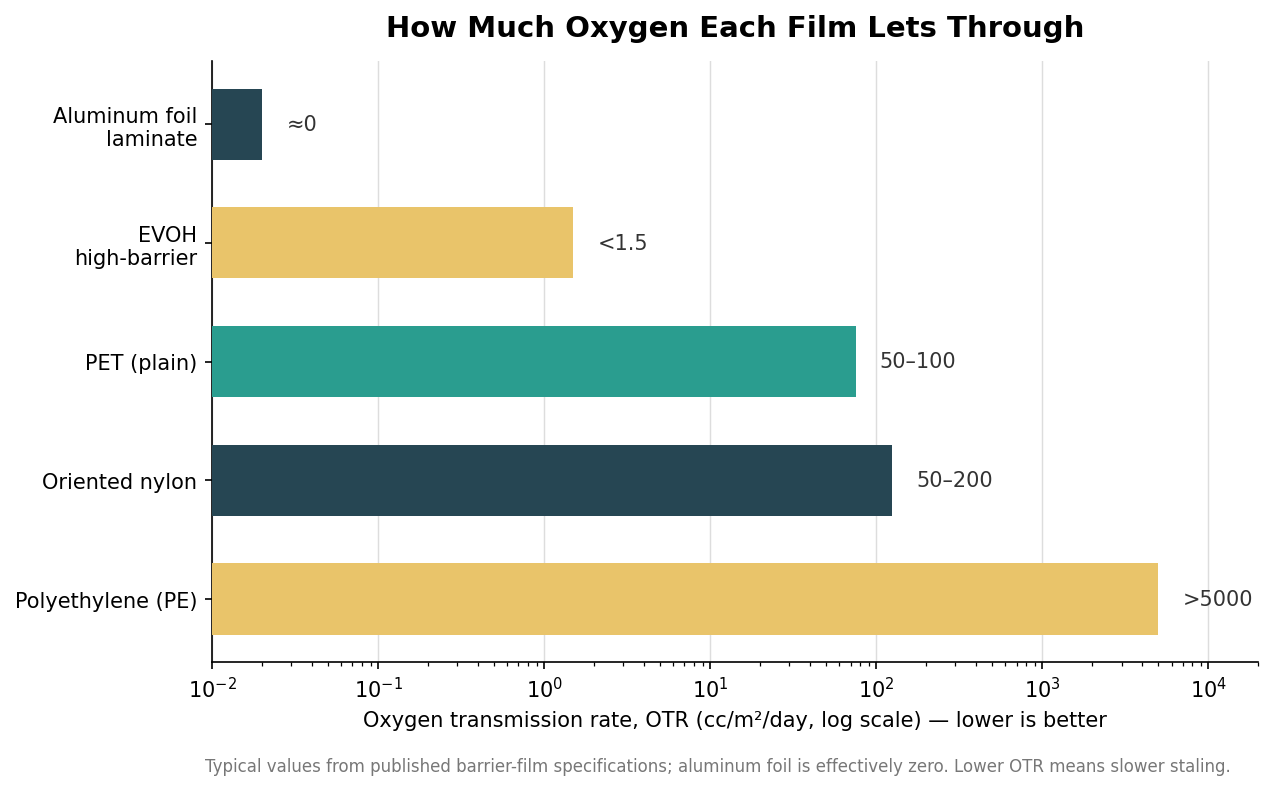
    Horizontal log-scale bar chart of oxygen transmission rate for foil, EVOH, PET, nylon, and polyethylene films
    Oxygen transmission rate by film type on a log scale; aluminum foil is effectively impermeable.

    Why fresh roast cannot be sealed airtight

    Even a perfect barrier fails without a valve, and the reason is the coffee itself. Freshly roasted beans off-gas carbon dioxide for days after roasting, up to around ten liters per kilogram. Seal that into an airtight foil bag and it inflates like a balloon and can split a seam. The one-way degassing valve solves it: it opens under the internal pressure to let CO2 escape, then closes so outside oxygen cannot get back in once pressure equalizes. That one component is what lets a roaster bag coffee within hours of roasting instead of waiting days for it to settle. The barrier and the valve are a pair, not alternatives; a valve on a poor-barrier bag still lets oxygen in around the clock, and a foil bag without a valve either bursts or forces a delay that costs freshness on the front end.

    Foil versus recyclable high-barrier

    The main tradeoff in coffee packaging today is barrier against recyclability. Foil gives the best oxygen barrier there is, but a foil laminate is not curbside recyclable because the metal layer cannot be separated from the plastics. A metal-free high-barrier structure such as PET/EVOH-PE gives up a little barrier in exchange for a recyclable, single-stream-friendly bag. In shelf-life terms, a PET/foil/PE bag with a valve holds quality for roughly 250 days at 20 degrees Celsius, and past 600 days when kept cool near 10 degrees, while a recyclable EVOH high-barrier bag typically protects an unopened bag for about 8 to 12 months. Treat those as indicative, unopened figures at controlled temperature; real shelf life depends on roast level, how oily the bean is, and how warm the storeroom gets in August.
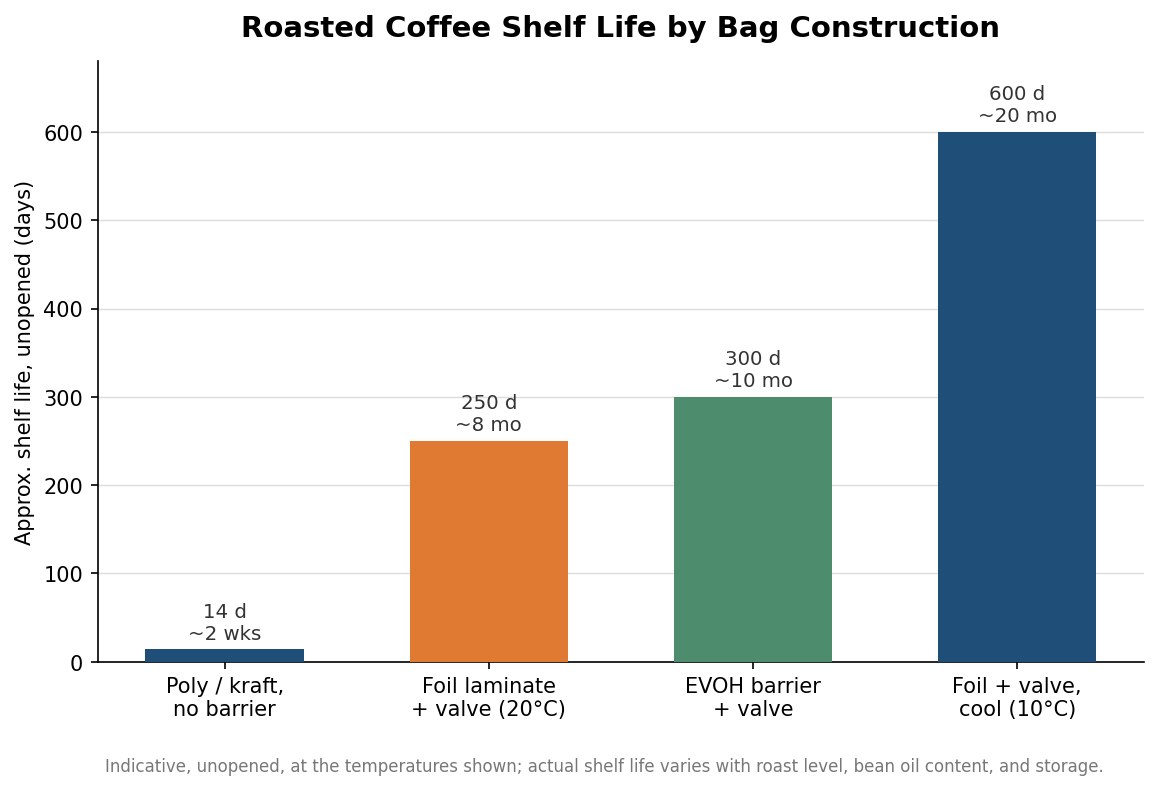
    Bar chart of approximate roasted coffee shelf life in days by bag construction and storage temperature
    Approximate unopened shelf life by bag construction, from a bare poly bag to cool-stored foil with a valve.

    What to spec for your shelf-life target

    Work backward from how long the coffee actually needs to survive. A fast-turnover subscription that ships within days of roasting can lean on a lighter structure, because the coffee is brewed long before oxygen becomes the story. A retail bag that may sit on a shelf for months needs foil or a strong EVOH barrier paired with a valve. Wholesale and export, where the coffee travels and waits, is where nitrogen flushing earns its keep, purging oxygen from the headspace at the moment of filling so the barrier starts from near-zero oxygen rather than sealing in a bag full of room air. Whatever the target, confirm three things with your supplier: the OTR of the film, the presence and rating of the valve, and the seal integrity, because the strongest laminate in the world still leaks through a weak seal.

    The bag is food engineering

    A custom coffee bag is not packaging in the decorative sense; it is a small piece of food engineering that happens to carry your logo. Match the barrier to your shelf-life window, add a valve so you can bag fresh, keep it out of the light and the heat, and the coffee arrives tasting the way it did on the cupping table. Every figure here is a starting point rather than a promise, so confirm the OTR, the valve rating, and the shelf-life claim against your own coffee and your supplier’s spec sheet before you commit a print run.
  • Coffee Bag Formats Compared: Side-Gusset, Stand-Up Pouch, and Flat-Bottom

    Coffee Bag Formats Compared: Side-Gusset, Stand-Up Pouch, and Flat-Bottom

    Two coffee bags can hold the same twelve ounces of beans and give a customer completely different impressions on the shelf. The difference is the format, the structural style of the bag, and it decides how the package stands, how much room you get for artwork, and how it fits the way you actually sell. Roasters tend to obsess over materials and valves, which matter, but the format is the choice a shopper reads first from across the aisle. This is a straight comparison of the three formats most specialty roasters choose between, and how to match one to the way your coffee moves.

    The three to know are the side-gusset bag, the stand-up pouch, and the flat-bottom bag, also called a quad-seal or box-bottom. They are not just cosmetic variations. Each has a different number of printable surfaces, a different footprint on the shelf, and a different sweet spot for size and sales channel.

    Side-gusset: the traditional coffee brick

    The side-gusset bag is the shape most people picture when they think of coffee packaging: tall and narrow, with pleats folded into both sides that expand as the bag fills, giving it that classic brick silhouette. It is the workhorse of the industry for good reasons. It runs well on high-speed filling equipment, uses material efficiently, and holds a lot of coffee in a compact footprint, which is why it dominates the one-pound and larger sizes aimed at regular drinkers and wholesale accounts.

    Its trade-off is display. The pleated sides mean your artwork really lives on the two main faces, and the bag reads as functional rather than boutique. A tin tie across the top is the common closure, folding down over the top seal. If your coffee sells mostly to people who already know they want it, by the pound, by subscription, or into cafes, the side-gusset does the job with the least packaging cost per bag.

    Stand-up pouch: the retail and online default

    The stand-up pouch, sometimes called a doypack, has a rounded bottom gusset that lets it stand on its own once filled. It is compact, modern, and photographs well, which is exactly why it has become the default for online sales and smaller retail sizes. A resealable zipper across the top is standard, and a hang hole lets it go on a peg as easily as a shelf. For sample sizes and the eight-to-twelve-ounce range that dominates direct-to-consumer, it is hard to beat on flexibility.

    Like the side-gusset, its printable area is essentially the front and back, so complex wrap-around artwork is not its strength. What it offers instead is a clean, upright face that looks good in a product photo and a shape that ships and stores efficiently. If most of your bags are opened by the customer who bought them online, the stand-up pouch is usually the pragmatic pick.

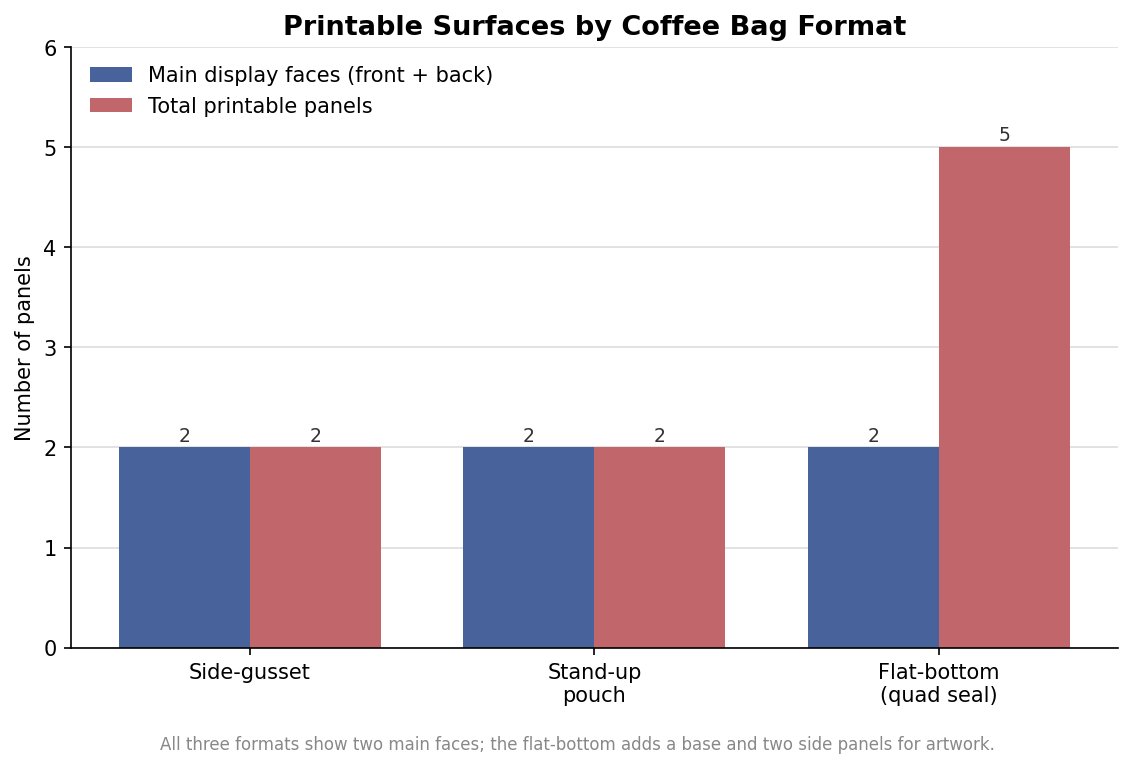
    Grouped bar chart comparing main display faces and total printable panels for side-gusset, stand-up pouch, and flat-bottom bags
    All three formats give two main display faces; only the flat-bottom adds a base and two side panels, for five printable surfaces.

    Flat-bottom: the premium shelf statement

    The flat-bottom bag, built with a quad seal and a rigid base, stands tall and square like a small box. It is the most structured of the three and the one that most clearly says premium. The reason goes beyond looks: because of how it is constructed, it gives you up to five printable panels, the front, back, the flat base, and both sides, instead of the two you get on the other formats. That extra real estate is room for a story, brewing notes, or origin detail without crowding the main face.

    The trade-offs are cost and fit. Flat-bottom bags typically carry a higher unit price and can require a higher minimum order, and they take up more shelf depth than a side-gusset holding the same weight. They shine for specialty and gift-oriented coffee where the package is part of the product, and they can look oversized on a bag meant to be bought by the pound and thrown in a pantry. If you are competing on shelf presence in a specialty grocer or building a gift-worthy line, the flat-bottom earns its premium.

    Then choose the size for the customer, not the format

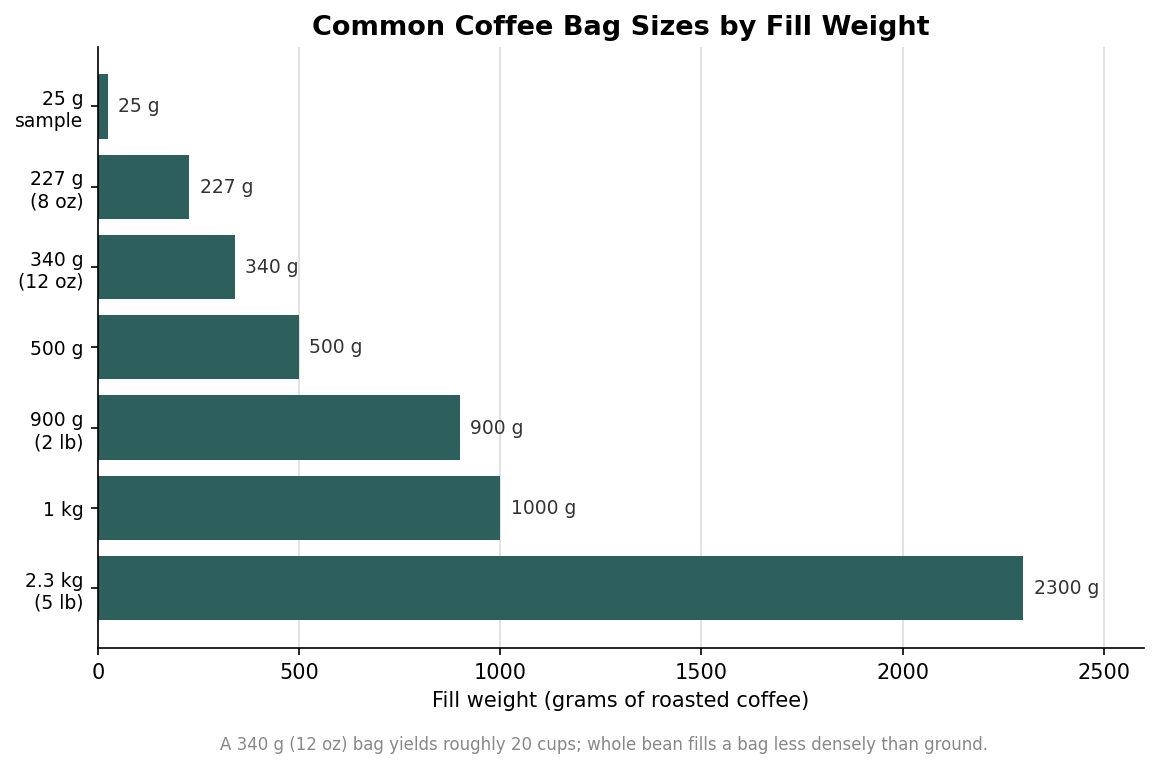
    Format and size are separate decisions, and the size should follow how your customer buys. A handful of weights cover almost the entire market. A 25-gram pouch is a sample or promo. The 227-gram, or 8-ounce, bag suits customers sampling several roasts. The 340-gram, or 12-ounce, bag is the North American retail standard and yields roughly twenty cups. From there, 500 grams, 900 grams (about two pounds), one kilogram, and the 2.3-kilogram (5-pound) bulk bag serve progressively heavier or wholesale buyers.

    Horizontal bar chart of common coffee bag fill weights from 25 grams to 2.3 kilograms
    The common stock sizes span from a 25 g sample to a 2.3 kg (5 lb) bulk bag, with 340 g (12 oz) as the North American retail standard.

    Most roasters land on three or four sizes rather than one, typically a small retail bag, a standard bag, and a bulk option. One detail worth keeping in mind when you spec dimensions: whole beans fill a bag less densely than ground coffee, so a bag sized snugly for ground product can look underfilled when you put the same weight of whole bean into it. If you sell both, size the bag to the whole-bean fill so neither version looks skimpy. These weights are the common stock sizes; a packaging supplier can confirm the exact bag dimensions that hold each fill for your particular bean density.

    Features ride on top of any format

    The parts people fixate on, the one-way degassing valve that lets fresh-roasted carbon dioxide escape without letting oxygen in, and the resealable zipper or tin tie, are available across all three formats. They are not what separates the bags. That means you can pick the format for how you sell and the size for how your customer buys, then add the valve and closure as near-universal options on top. Decide the structure first, in other words, and treat the valve and zipper as the checkboxes they are rather than the headline. Get the format matched to your channel and the size matched to your buyer, and the bag will do its job on the shelf and in the cupboard.

  • Compostable vs. Recyclable Coffee Bags: What Actually Breaks Down

    Compostable vs. Recyclable Coffee Bags: What Actually Breaks Down

    Sustainability is now a shelf claim, and coffee is one of the categories where customers read the back of the bag. The trouble is that compostable and recyclable are not two grades of the same thing — they are two different end-of-life routes with different materials, different barrier performance, and very different real-world outcomes depending on where your customer lives. Getting this decision right protects both the roast and the claim.

    The Three Routes, Honestly Compared

    Certified compostableStore drop-off recyclableConventional high-barrier
    Typical structureKraft or cellulose with PLA/PBAT barrierMono-material polyethylene laminateFoil or metallised multi-laminate
    Oxygen barrierGood, improving each yearGoodBest available
    Practical shelf lifeShortest of the threeLongLongest
    What the customer doesIndustrial compost, where acceptedReturns film to a store drop-off pointGeneral waste
    Best fitSubscription and cafe bags drunk quicklyRetail programmes in film-collecting marketsExport, long transit, high-value single origin

    Compostable: Read the Certification, Not the Colour

    Brown kraft with a leaf printed on it means nothing on its own. A genuine compostable bag carries a recognised certification against an industrial-composting standard, and that certification has to cover the whole construction — film, inks, adhesives, zipper, and the degassing valve. A bag that is certified except for its valve is not a certified bag, and that is the most common gap we see on artwork brought over from another supplier.

    The second thing to be straight about is what industrial means. Most certified compostable coffee packaging needs the sustained heat of a commercial composting facility; it will not reliably break down in a garden heap, and it should not go in the recycling stream, where it contaminates the film bale. If your customers are largely in areas without commercial composting collection, a compostable bag is an honest material choice with a dishonest-sounding claim, and wording it carefully on the back panel matters.

    Tip: Whichever route you pick, print the disposal instruction on the bag rather than only on your website. The person holding the empty bag is the one making the decision, and they are not going to look it up.

    Recyclable: The Mono-Material Trade

    Conventional high-barrier coffee bags are laminates of several different plastics, sometimes with an aluminium layer, and that mix is exactly what makes them unrecyclable in practice. A recyclable coffee bag solves it by building the whole structure from one polymer family — typically polyethylene — so the empty bag can go into store drop-off film collection.

    The trade is that a mono-material film has to work harder to reach the barrier a foil laminate gets for free, so structures are thicker and the specification is less forgiving. It is a strong choice for a retail programme in a market with real film collection, and a weaker one if your bags spend months in transit or sit in warm storage.

    Conventional High Barrier Is Still the Right Answer Sometimes

    If you are shipping a high-value single origin across an ocean, or packing at a moisture and temperature you cannot control downstream, the sustainable choice may be the bag that keeps the coffee drinkable. Coffee thrown away because it staled early has a far worse footprint than the laminate it was sitting in. Where that is the case, the more useful sustainability lever is bag size: fewer, larger bags per kilo of coffee beats a compostable claim on a bag that failed.

    How to Decide in Five Minutes

    Answer three questions. How long between packing and brewing — weeks, or months? Where do your customers actually live, and does that market collect film or run commercial composting? And is the claim central to your brand, or a nice-to-have? Fast turnover plus a composting market plus a sustainability-led brand points to compostable. Long transit, wide distribution, or a premium single origin points to a high-barrier valve bag, with bag-size discipline doing the environmental work.

    We will send you printed samples in more than one structure so you can seal your own coffee in each and taste the difference at two weeks and at six. Minimum order is twelve units per design, and standard production runs about two weeks from artwork approval. See all formats on the products page, or start with the buyer’s guide.

    Want to compare structures side by side?

    Tell us your roast, your markets and how fast your coffee moves. We will send samples in each route and quote within one business day.

    Get a Quote

    Home · About · Quotes answered within one business day

  • Degassing Valves Explained: Why Freshly Roasted Coffee Needs One

    Degassing Valves Explained: Why Freshly Roasted Coffee Needs One

    Roasted coffee is not a finished product when it leaves the drum. For days afterwards it keeps releasing carbon dioxide created during roasting — a fast, heavy release in the first twenty-four hours, tapering over one to two weeks. Seal that coffee into a high-barrier laminate with nowhere for the gas to go and the bag inflates, strains its seals, and eventually splits. Leave the bag open enough to breathe out and oxygen breathes in, staling the roast. The one-way degassing valve is the small component that resolves the contradiction, and it is the single most misunderstood spec on a custom coffee bag.

    How a One-Way Valve Actually Works

    A degassing valve is a small plastic disc heat-welded to the inside of the bag film over a punched hole. Between the disc and the film sits a thin membrane held against the seat by a film of food-grade oil or a light spring. When internal pressure rises past the valve’s cracking pressure, the membrane lifts and CO2 escapes. When pressure equalises, the membrane reseats and the oil film re-forms the seal, so ambient oxygen and moisture cannot travel back in. It is a check valve small enough to disappear into your artwork.

    Two numbers describe it. Cracking pressure is the differential at which the valve opens; typical coffee valves sit in a low range so gas leaves before the seals are stressed. Flow rate is how quickly it can vent once open. A dark roast in a large format is producing a lot more gas in the first day than a light roast in a retail bag, so format and roast profile both feed into the valve you should be running.

    When You Need One — and When You Do Not

    SituationValve?Why
    Whole bean, packed within days of roastYesPeak degassing happens in the bag; without a valve it will balloon
    Ground coffee, packed freshYesGrinding releases gas faster, not slower — the pressure arrives sooner
    Coffee rested several weeks before packingOptionalMost gas is already gone; a valve adds cost without much benefit
    Sample sachets and single-serve sizesUsually noSmall headspace and small volumes rarely build meaningful pressure
    Nitrogen-flushed bagsYesFlushing displaces oxygen but does nothing about the CO2 still to come
    Tip: If your bags are arriving at retail visibly puffed, that is not always a valve failure — check that the valve was not sealed over during filling, and that your fill line is not trapping the valve under the pack’s own folded gusset.

    Placement, and Why It Matters More Than People Expect

    The valve is applied before the bag is formed, so its position is fixed at manufacture and has to be designed into the artwork rather than added afterwards. On a side-gusset bag the valve normally sits on the back panel in the upper third, clear of the gusset fold so the fold cannot mask it. On a flat-bottom bag there is room to place it on a side panel, which keeps the front face completely clean for brand artwork. On a stand-up pouch the valve goes on the back, above the fill line, so it never sits below the coffee where oil can foul the membrane.

    Two rules save reprints. Keep the valve out of any area where a shelf-edge label or a sustainability mark will later be applied, and keep dense flood ink off the valve seat — a heavy ink build under the weld can compromise the bond.

    Valves and Your Barrier Choice

    A valve is only as good as the film around it. Pairing a high-flow valve with a low-barrier laminate solves the pressure problem and leaves the oxygen problem untouched, and the coffee still tastes flat at week four. Foil and metallised structures give the strongest oxygen and light barrier; clear-window constructions trade a measure of light protection for the merchandising value of showing the bean, which is often the right call for a retail shelf. Compostable structures have improved sharply, and valves are now available in materials that are certified alongside the film, so a compostable bag no longer has to leave a plastic disc behind.

    Specifying It on a Real Order

    Bring four things and the spec writes itself: your roast profile and how soon after roasting you pack; your fill weight and format; whether you nitrogen-flush; and whether the programme has to be compostable or recyclable end-to-end. From there we recommend a valve type and placement, mark it on the dieline, and send a printed sample so you can seal your own coffee in it before committing to a run. Minimum order is twelve units per design and standard production runs about two weeks after artwork approval.

    Compare formats and barrier structures on the products page, or read the full buyer’s guide for how valve choice fits alongside closure and print method.

    Not sure which valve your roast needs?

    Send us your roast profile, format and fill weight. We will recommend the valve and placement, mark it on your dieline, and quote within one business day.

    Get a Quote

    Home · About · Quotes answered within one business day